Why choose a laser projector
A laser projector replaces the lamp with a solid-state laser light source. For a home theater that has three practical effects. First, there is no lamp to replace: manufacturers rate laser light sources for many thousands of hours, so for most owners the light source outlasts the projector's useful life. Second, laser projectors reach full brightness quickly and can be switched on and off without a warm-up and cool-down delay. Third, brightness holds up more steadily over time than a lamp, which dims as it ages. Our laser vs lamp projector guide covers the tradeoffs in more detail.
The cost is price. A laser projector usually sits a tier above a comparable lamp projector, so the question is whether you will keep it long enough to enjoy the savings. For a dedicated theater you plan to use for years, laser is the right buy.
Standard throw or ultra short throw
Laser projectors come in two layouts. A standard throw model sits on a shelf or the ceiling and projects across the room, so it needs a distance of roughly one to two times the screen width. An ultra short throw (UST) model sits within a foot or two of the wall and projects up and out, so no ceiling mount or long cable run is needed. The UST models here are the Hisense PX3-PRO, AWOL LTV-3000 Pro and Epson LS800. For a deeper look at that category, see our best UST projector guide.
How we chose these six
We built this list from manufacturer specifications and the product details Amazon publishes for each model, not from a lab. Each projector is a 4K laser model that is in stock on Amazon as of this update, with a mix of standard throw and UST layouts. We favored 4K resolution, HDR support and features that matter in a living room, such as built-in streaming and eARC audio return. We do not publish ratings or test scores, and every brightness or contrast number below is the manufacturer's own claim.
Laser Projector Reviews

Epson Home Cinema LS6000
Best OverallThe Epson Home Cinema LS6000 uses a 3-chip 3LCD engine with a laser light source. Epson rates it at 3,400 lumens of both color brightness and white brightness, lists an 800,000:1 dynamic contrast ratio, and describes full 10-bit HDR processing with HDR10 and HLG. Its multi-element Epson Cinema Lens supports screen sizes up to 300 inches, and it has two HDMI ports that support 120Hz, one with eARC.
It is the pick because it balances brightness and picture quality. Because a 3LCD design shows color and white at the same brightness, the picture stays vivid in a room that is not fully dark, which is where single-chip DLP projectors can look washed out. It does not have built-in streaming, so plan on a streaming stick or box, and it is a standard throw model that needs a shelf or ceiling mount.
- 4K, 3-chip 3LCD, laser
- 3,400 lumens color and white (maker rating)
- 800,000:1 dynamic contrast (maker claim)
- Two HDMI 120Hz ports, one eARC
Pros: Bright, equal color and white brightness, big lens range, wide screen sizes, HDR10 and HLG.
Cons: Needs a mount or shelf and a streaming box; premium tier.

Hisense PX3-PRO
Best Ultra Short ThrowThe Hisense PX3-PRO is an ultra short throw projector with a triple laser (red, green and blue) light source. Hisense lists 3,000 lumens, a 3000:1 contrast ratio, an 80 to 150 inch image size, Dolby Vision and Atmos support, and a 110 percent BT.2020 color gamut.
We chose it for the living room because the UST layout is what makes a projector a TV replacement: it goes on a cabinet below the screen, no ceiling mount needed. Use the throw distance calculator to confirm the distance for your screen, and pair it with an ambient light rejecting screen to get the best of the 3,000 lumens in daylight; our best projector screens guide has options.
- 4K UST, triple laser
- 3,000 lumens (maker claim)
- 80 to 150 inch image
- Dolby Vision, Atmos, IMAX Enhanced
Pros: No ceiling mount, triple laser color, large image from a short distance, Dolby Vision and Atmos.
Cons: Works best with a matching ALR screen; premium tier.

XGIMI HORIZON 20 Pro
Best Smart LaserThe XGIMI HORIZON 20 Pro is an RGB triple laser projector rated by XGIMI at 4,100 ISO lumens with a claimed 20,000:1 contrast ratio. It includes optical zoom and lens shift, Google TV with licensed Netflix, and gaming features of 1ms response, up to 240Hz, VRR and ALLM.
It stands out for flexibility. Optical zoom and lens shift give you room to place the projector on a table or ceiling without being locked to one distance, which matters in a rented or living space where placement is constrained. The listing notes that triple laser designs can show slight speckle for a small share of viewers and suggests an ALR screen and a viewing distance beyond nine feet. That is worth knowing before you buy.
- 4K RGB triple laser
- 4,100 ISO lumens (maker claim)
- Optical zoom and lens shift
- Google TV, 240Hz gaming
Pros: Built-in smart platform, flexible placement, strong brightness, gaming specs.
Cons: Speckle can be visible to a small percentage of viewers; a screen upgrade helps.
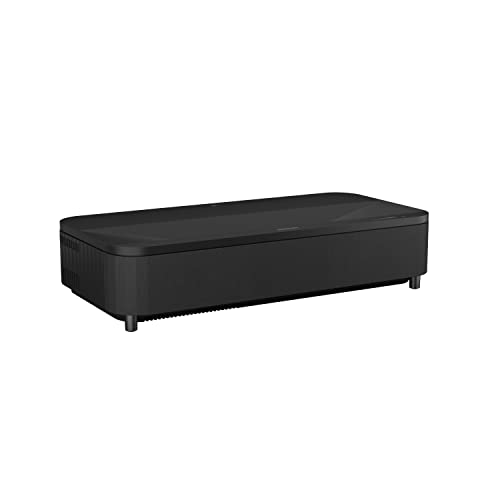
Epson EpiqVision Ultra LS800
Best 3LCD USTThe Epson EpiqVision Ultra LS800 is an ultra short throw 3-chip 3LCD laser projector. Epson lists 4,000 lumens, 4K PRO-UHD resolution, HDR support, a 150 inch class image, and a built-in Android TV streaming platform.
Where the Hisense is a triple-laser DLP, the LS800 uses Epson's 3LCD approach, which is a good fit if you want a UST that stays vivid in a living room. The tradeoff is size and weight: UST projectors are large boxes, so measure the cabinet or media stand before you buy.
- 4K PRO-UHD, 3LCD laser
- 4,000 lumens (maker claim)
- 150 inch class image
- Android TV built in
Pros: Bright for a UST, built-in streaming, 3LCD color brightness.
Cons: Large chassis; UST needs a flat wall and ideally an ALR screen.
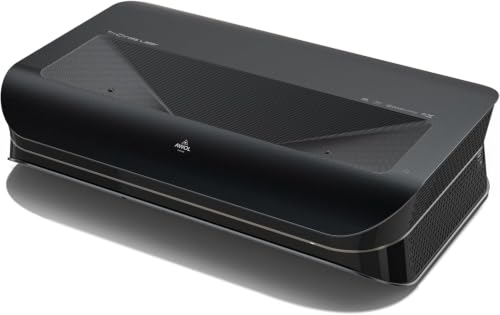
AWOL VISION LTV-3000 Pro
Best UST ValueThe AWOL VISION LTV-3000 Pro is a 4K triple laser UST projector. Its listing describes Dolby Vision, HDR10+, Dolby Atmos, 3D support with active shutter glasses, PJLink IP control, 107 percent BT.2020 and 147 percent DCI-P3 color coverage, and a built-in center-channel speaker meant to pull dialogue toward the screen.
It earns the value spot for UST because it packs in features that cost more elsewhere, including 3D for owners of 3D Blu-rays. If you build a surround system around it, the built-in center channel is a clever touch. Check the brightness spec against your room with the brightness calculator.
- 4K UST triple laser
- Dolby Vision, HDR10+, Atmos
- 3D with active shutter glasses
- Built-in center speaker
Pros: Triple laser UST at a mid tier, 3D support, home automation control.
Cons: A smaller brand than Epson or Hisense; best with AWOL or another ALR screen.
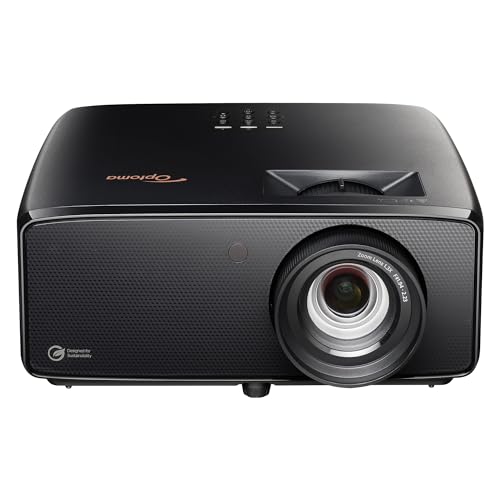
Optoma UHZ36
Best Budget LaserThe Optoma UHZ36 is a 4K UHD laser projector. Its listing is brief: it highlights 4K UHD, HDR support, and Filmmaker Mode, which preserves the director's original picture settings.
We include it as the lowest-tier way into 4K laser on this page. Because the listing carries few specifications, check Optoma's own product page for lumens, throw ratio and input lag before you buy. It is a good fit for a dim room where you want a lamp-free projector without paying for premium optics.
- 4K UHD laser
- HDR support
- Filmmaker Mode
- Standard throw
Pros: Lowest tier for 4K laser here, lamp-free, Filmmaker Mode.
Cons: Few published specs on the listing; verify brightness and throw ratio for your room.
How bright should a laser projector be?
Brightness depends on the screen and room. A dedicated dark room is happy with 2,000 to 2,500 lumens. A living room with lights on needs 3,000 or more, plus an ALR screen. Our lumens chart and brightness calculator do the math for your screen size.
Screens matter as much as the projector
A laser projector is only as good as the surface it hits. For UST models an ALR screen is nearly required, and for standard throw models a quality fixed-frame screen sharpens the picture. See the best projector screens guide.
Plan the mount and the sound
For standard throw models, plan for a ceiling mount; our projector mounts guide covers options, and how to mount a projector on the ceiling walks through the install. Most projectors have weak speakers, so pair one with a soundbar or receiver; see home theater speaker systems.