When towers beat bookshelf speakers
Floor standing speakers earn their space in medium and large rooms. Their taller cabinets hold more woofers and more internal volume, so they reach lower and play louder before the subwoofer needs to help. They also place the tweeter near ear level without a stand, which is simpler, and they fill the front of the room with sound in a way that a small bookshelf pair does not.
You still want a subwoofer. Even a tower with two 6.5-inch woofers will not reproduce the deepest effects in a film, and a sub in a home theater also relieves the towers from the heaviest bass so that dialogue and music stay clean at high volume. The best home theater subwoofers guide has options at every budget.
How we picked these six
We chose towers that are sold on Amazon and in stock, that come from established speaker companies, and that span a wide range of prices. Specifications come from manufacturer listings and the product details Amazon provides, and we did not run measurements. We prioritized speakers with efficient designs, because high efficiency lets an entry-level AV receiver reach loud levels without strain, and we included Atmos-ready and Atmos-compatible towers for people building a height-channel system.
Floor Standing Speaker Reviews
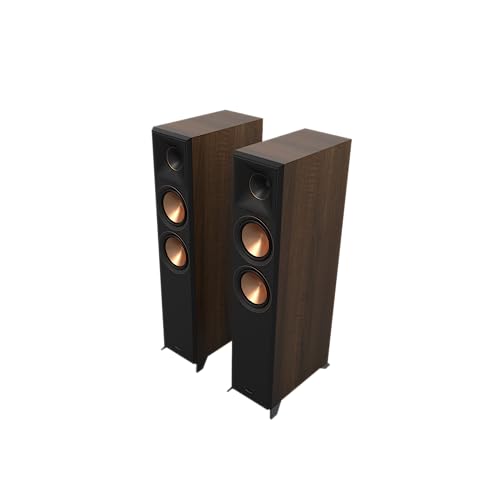
Klipsch Reference Premiere RP-6000F II (Pair)
Best OverallThe Klipsch RP-6000F II pair is built around a larger 90 by 90 degree hybrid Tractrix horn with a 1-inch LTS titanium diaphragm tweeter, plus Cerametallic woofers that Klipsch updated for this generation. The listing also describes simple, hidden connections on the back that make a future upgrade to Dolby Atmos easy.
Efficient horn designs like this are loved by home theater buyers because they are dynamic: dialogue and effects have punch without the receiver working hard. The size and the premium tier mean it suits a dedicated room or a large living room. Pair it with a Klipsch Reference Premiere center from our center channel guide, and plan a subwoofer to fill the deepest octave.
- 1" LTS titanium tweeter
- Hybrid 90x90 Tractrix horn
- Cerametallic woofers
- Atmos upgrade connections
Pros: Very dynamic, efficient, designed with Atmos in mind, strong front stage for movies.
Cons: Premium tier and a large footprint; the horn tweeter is lively in hard-surfaced rooms.
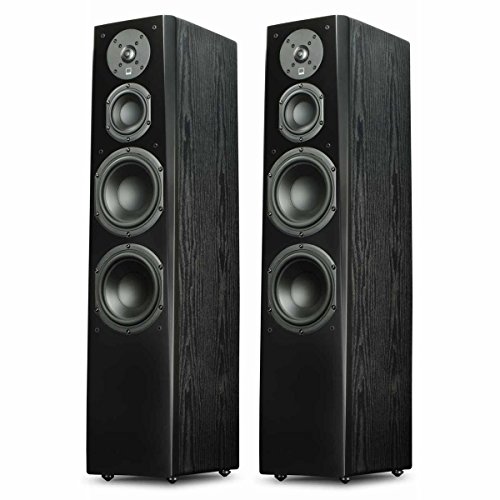
SVS Prime Tower (Pair)
Best High-End ValueThe SVS Prime Tower uses a 4.5-inch midrange driver in its own dedicated, sealed compartment, plus dual 6.5-inch woofers and a proprietary 3.5-way SoundMatch crossover, according to SVS. The goal is a smooth, tonally balanced speaker that works for movies and for critical music listening.
If your room does double duty as a music room, this is the tower that rewards it. It is a good fit for a large room with a capable receiver, and it matches the SVS Prime Center and Prime Bookshelf, so you can build a whole system from one family. It is not the most efficient speaker here, so pair it with a receiver that has real power.
- 4.5" sealed midrange
- Dual 6.5" woofers
- 3.5-way crossover
- Matches Prime center and bookshelf
Pros: Smooth, balanced tone, works for music and movies, matching family.
Cons: Premium tier and needs a stronger receiver than the efficient Klipsch designs.

Klipsch Reference R-26FA (Pair)
Best Atmos TowerThe Klipsch R-26FA is a floorstanding speaker with an integrated elevation speaker for Dolby Atmos, according to the listing. It uses a 1-inch aluminum compression driver on a 90 by 90 degree Tractrix horn and dual 6.5-inch copper-spun woofers, with a front-firing port and dual binding posts.
Built-in elevation channels make it the easiest route to Atmos if you cannot cut into a ceiling. You run one more pair of speaker wires per tower and set your receiver for height speakers. Read the best in-ceiling Atmos speakers guide if your ceiling allows a more precise layout.
- Integrated Atmos elevation speaker
- Dual 6.5" copper-spun woofers
- 1" aluminum compression driver
- 100W / 400W peak power handling
Pros: Atmos without ceiling work, strong dynamics, dual binding posts.
Cons: Needs extra speaker wire and channels on the receiver; elevation effects are smaller than a true ceiling layout.

Klipsch Reference R-620F (Pair)
Best Mid-RangeThe Klipsch R-620F lists a frequency response of 38 Hz to 21 kHz plus or minus 3 dB, a 1-inch aluminum LTS tweeter on a 90 by 90 Tractrix horn, dual 6.5-inch spun-copper woofers and rear-firing ports. Power handling is 100 watts continuous and 400 watts peak.
It is the middle step in the Klipsch Reference line and the one we recommend for most medium and large rooms on a mid-range budget. The rated low end means less work for your subwoofer, and the horn tweeter keeps dialogue clear.
- 38 Hz to 21 kHz response
- Dual 6.5" copper woofers
- 1" LTS tweeter on horn
- Rear-firing ports
Pros: Strong low end for the tier, dynamic, easy to drive.
Cons: Rear ports need space behind the speaker; the sound is bright in hard rooms.
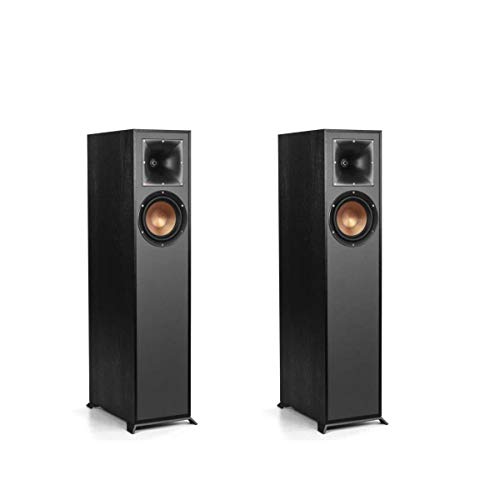
Klipsch Reference R-610F (Pair)
Best ValueThe Klipsch R-610F lists a frequency response of 45 Hz to 21 kHz, 94 dB sensitivity, 8-ohm impedance, and power handling of 85 watts continuous and 340 watts peak. It uses a 1-inch aluminum LTS tweeter on a 90 by 90 square Tractrix horn.
It is the tower pair to buy when budget matters most. The high sensitivity means a modest receiver can drive it to satisfying volume, and it matches the Klipsch R-52C center from our center channel guide. Expect less bass extension than the 620F, so a subwoofer matters more.
- 45 Hz to 21 kHz response
- 94 dB sensitivity
- 8 ohm impedance
- 85W / 340W peak
Pros: Efficient and loud, strong value, pairs with entry-level receivers.
Cons: Less bass extension than larger towers; horn voicing can sound bright.

Polk Audio Monitor XT70 (Each)
Best Budget TowerThe Polk Monitor XT70 is sold as a single speaker, so buy two for a front pair. It has a 1-inch tweeter, two 6.5-inch woofers and two 8-inch passive radiators, and Polk lists compatibility with Dolby Atmos and DTS:X sources and with 4-ohm and 8-ohm receivers.
The passive radiators add bass without a port, which can be handy if you need to place the tower closer to a wall. As part of the Monitor XT family it pairs with the XT30 center and XT15 bookshelf speakers, which makes a budget 5.1 system easy to assemble.
- 1" tweeter
- Dual 6.5" woofers
- Dual 8" passive radiators
- Atmos and DTS:X compatible
Pros: Low cost, portless bass, matching family with a center and bookshelf speakers.
Cons: Sold individually, so double the cost; less output than the Klipsch horn designs.
Room size and tower speakers
A tower works best when the room is large enough to give it breathing room. As a rule of thumb, rooms under about 1,500 cubic feet often do better with bookshelf speakers and a sub, while rooms over that benefit from the output of a tower. Measure the room, then enter the dimensions in the speaker sizing calculator. Our best bookshelf speakers for home theater guide covers the smaller option.
Placement and toe-in
Place the front towers on either side of the screen at about the same distance from the seating position as from each other, which creates an equilateral triangle. Pull them away from the front wall by at least a foot for rear-ported designs, and toe them in slightly if the room is wide. Use the speaker placement calculator for distances.
Efficiency and receiver power
Sensitivity tells you how loud a speaker plays for a given power. A speaker rated at 94 dB or more reaches a loud level from a modest receiver, while a speaker with lower sensitivity needs more power. If you plan to push levels, check the receiver wattage in our best home theater receivers and best AV receivers under $1,000 guides.
Towers and the subwoofer
Set the towers to small in the receiver menu and let the subwoofer carry bass below the crossover, typically 60 to 80 Hz for towers. This takes the heaviest work off the towers and keeps the sound clean at volume. Some people run towers as large and rely on the subwoofer only for the effects channel; try both and pick the cleaner result.