A great outdoor movie night needs more than a bright projector - the screen makes or breaks the picture. Projecting onto a bedsheet or a fence works in a pinch, but wrinkles, sag, and a dull surface rob you of brightness and sharpness. A proper outdoor projector screen gives you a taut, bright, evenly-lit image and packs away when you are done.
Below are the best outdoor projector screens for 2026, from quick-inflating blow-up screens to tensioned snap-frame screens and budget foldable options. Size your screen to your seating distance with our outdoor screen size calculator, and pair it with the right projector from our best outdoor projectors guide; for a grab-and-go setup, the battery-powered Anker Nebula Mars 3 is our favorite portable pick.
What to Look For
- Type: inflatable screens set up fastest and go biggest; tensioned snap-frame screens give the flattest, highest-quality surface; foldable fabric screens are cheapest and most packable.
- Tension & flatness: a wrinkle-free, taut surface is essential - wrinkles cast shadows and distort the image. Tensioned or inflatable screens beat loose hang-up sheets.
- Size: bigger needs more projector brightness and more throw distance. Match screen size to your yard and seating with a screen-size calculator.
- Wind & stakes: outdoor screens catch wind like a sail - look for included stakes, guy-lines, and sandbag points, and never leave a screen up unattended in gusts.
- Front vs rear projection: most setups use front projection; some screens support rear projection so the projector and cables stay behind the screen, out of the seating area.
A tensioned screen holds its surface taut with a rigid frame or a built-in tension system so the fabric cannot sag or ripple, which is what keeps projected lines straight and edges sharp outdoors. Indoors the trade-offs are different, and our guide to the best projector screens covers fixed-frame, motorized, and ALR options for a room you can darken. If you are planning a big picture, a 150 inch screen is 10.9 feet wide and needs 9.8 to 19.6 feet of throw from a standard-throw projector, so measure the yard before you size up.
The Best Picks

Elite Screens Yard Master 2 DUAL (135")
Best OverallThe Yard Master 2 DUAL is a tensioned, snap-together aluminum-frame screen built specifically for the outdoors. The snap-button tensioned surface stays flat for a sharp image, the frame hardware uses stainless steel parts, and the WraithVeil Dual material supports both front and rear projection. It assembles in minutes without tools and ships with ground stakes, rigging cord and a carry bag. For most backyards, this is the best balance of image quality, durability, and convenience.
- 135" 16:9 tensioned snap-frame
- Front & rear projection
- Stakes + rigging cord
- Tool-free assembly
- Carry bag included

XHYCPY 16ft Inflatable Movie Screen
Best Inflatable (Easiest)An inflatable screen is the fastest way to a big backyard picture - a built-in blower inflates it in a couple of minutes, and stakes hold it down. The surface is large and bright, and kids love the spectacle. The trade-off is the constant low hum of the blower and slightly less flatness than a tensioned frame, but for easy, big, casual movie nights it is hard to beat.
- Inflates in ~2 minutes
- Blower + stakes + storage bag
- 16 ft, front/rear projection
- Quick takedown
- Great for kids/parties

QILEBA 24 ft Inflatable Projector Screen
Best Big InflatableFor larger gatherings, the QILEBA inflatable screen is a 24 ft unit with an included blower, tie-downs, and storage bag. It sets up fast and gives a huge, bright surface for a crowd. As with any inflatable, anchor it well and bring it in if the wind picks up.
- Large sizes available
- Blower + tie-downs + storage bag
- Fast setup
- Front or rear projection
- Storage bag

Elite Screens Yard Master Plus
Best Large / PremiumA larger, sturdier take on the tensioned outdoor screen, the Yard Master Plus suits big yards and semi-permanent setups where you want a flat, high-quality surface at 145 inches. It uses black-backed CineWhite UHD-B material at 1.3 gain for front projection only, on a height-adjustable frame with detachable T-legs.
- Large tensioned frame
- 145" 16:9
- Front projection, 1.3 gain
- Height adjustable
- Premium build

Elite Screens Yard Master Wireless (140")
Best Permanent Patio ScreenFor a covered patio or pergola where the screen should live outside all season, this is a motorized 140 inch roll-down screen in a steel case that mounts to a wall or ceiling. A built-in rechargeable battery runs the motor, so no outlet is needed (Elite quotes up to 200 up/down cycles per charge), and the case is rated IPX3 against light spray. The 1.1 gain matte white surface has a black backing for contrast.
- 140" 16:9, 1.1 gain
- Motorized, battery powered
- IPX3 weather resistance
- Wall or ceiling mount
- Steel case

Mdbebbron 120" Foldable Screen
Best BudgetThe most affordable way to upgrade from a bedsheet, this foldable anti-crease polyester screen can be hung from a wall, frame, or rope and pulled taut. It is not as flat as a tensioned frame and stubborn creases may need ironing/steaming out, but for the price it is a huge step up and packs into a small bag. It also supports double-sided front and rear projection.
- Foldable anti-crease polyester
- Hang from wall, frame, or rope
- 120" (other sizes too)
- Double-sided front & rear projection
- Very packable

Elite Screens Tripod Series
Best FreestandingA freestanding tripod screen pulls up in seconds and needs no wall, frame, or stakes - handy for patios, decks, or anywhere you cannot anchor a big screen. Sizes are smaller than inflatable or frame screens, but for quick, no-fuss movie nights (and double-duty indoors) it is the most convenient option.
- Freestanding tripod, 72" 16:9
- Pull-up in seconds
- No stakes/wall needed
- Indoor/outdoor use
- Height adjustable
Comparison at a Glance
| Screen | Type | Budget | Setup time | Best for |
|---|---|---|---|---|
| Elite Yard Master 2 DUAL 135" | Tensioned frame | Under $1,000 | Minutes | Best overall quality + durability |
| XHYCPY 16ft Inflatable | Inflatable | Under $100 | ~2 min | Easiest, biggest, kid-friendly |
| QILEBA 24 ft Inflatable | Inflatable | Under $250 | ~2 min | Big crowds |
| Elite Yard Master Plus | Tensioned frame | Under $1,000 | Minutes | Large / semi-permanent |
| Elite Yard Master Wireless 140" | Motorized roll-down | Under $2,500 | Seconds | Covered patio, permanent |
| Mdbebbron 120" Foldable | Foldable fabric | Under $25 | Minutes | Cheapest upgrade from a sheet |
| Elite Tripod Series | Freestanding | Under $250 | Seconds | No wall/stakes, patios |
The table above compares the seven screens by type, price, setup time, and best use, and the range runs from the under-$25 Mdbebbron foldable up to the under-$2,500 Elite Yard Master Wireless (140").
Inflatable or Fixed Frame? Pick the Type First
Almost every bad backyard screen purchase comes from choosing a size before choosing a type. The two families behave completely differently once the sun goes down and the wind picks up, and the right answer depends far more on how you will use the screen than on your budget.
Choose inflatable if the screen goes up for a party and comes down the same night, if you want the largest possible picture for the money, or if children are the main audience. A blower holds the frame rigid, setup is roughly two minutes, and 14 to 24 foot sizes cost less than a 120 inch tensioned frame. Choose a fixed or tensioned frame if the screen lives in one spot for a season, if you care about a genuinely flat surface for film, or if you cannot tolerate blower noise during quiet dialogue.
| Inflatable | Tensioned / fixed frame | |
|---|---|---|
| Setup time | About 2 minutes, blower does the work | Several minutes of assembly, tool free |
| Surface flatness | Good, slight give near the edges | Best, stays dead flat for sharp edges |
| Practical size | 14 to 24 ft, biggest picture per dollar | 100 to 145 in, costs climb with size |
| Noise | Constant low blower hum all night | Silent |
| Power needed | Yes, blower runs continuously | None |
| Wind behaviour | Large sail area, stake and tie down every point | Also a sail, but lower and easier to anchor |
| Best for | Parties, kids, occasional big nights | Film quality, a screen that lives outside |
Whichever type you choose, neither is safe unattended in gusty weather. Both present a large flat surface to the wind, so use every stake and guy line supplied, weight the base, and take the screen down if the wind rises.
Screen and Projector Packages
If you do not already own a projector, buying the screen on its own is only half the purchase. There are three sensible routes, and they suit very different budgets. An all-in-one kit is the cheapest way to get a picture on the wall tonight. A big inflatable package gets you a crowd-sized screen with every accessory in the box. Pairing a separate screen and projector costs more but is the only route that lets you upgrade one half later.

HP CC200 Projector and Screen Package
Best All-in-One KitThe simplest possible start: a native 1080p projector and an outdoor movie screen in one box, so there is nothing to match up and nothing left to buy. HP quotes an 84 inch image, motorised focus so you can square the picture up without crawling behind the projector, and an LED light source rated for over 20,000 hours, which for a few nights a month is effectively the life of the product. It takes a phone, tablet, laptop, streaming stick or DVD player over HDMI. Treat 84 inches as the honest working size rather than a maximum to push past, and plan to add a Bluetooth speaker, because built-in projector audio outdoors is always the weak link.
- Projector and screen in one package
- 84 in 1080p image
- Motorised focus
- LED source rated 20,000+ hours
- HDMI for phone, laptop or streaming stick
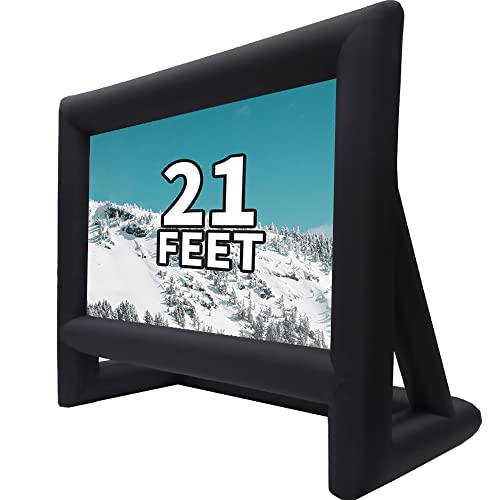
XHYCPY 21 ft Inflatable Screen Package
Best Big-Crowd PackageAt 21 feet this is block-party scale, and it ships as a complete kit rather than a bare screen: inflatable frame, detachable screen, air blower, rope, tent stakes and tie-down strings that connect to the frame itself. Setup is about two minutes. The screen is double-sided polyester, so you can project from the front or from behind, which is the trick for keeping cables and shadows out of the seating area. The black frame is 210D oxford cloth and the white screen detaches for cleaning and storage, which matters more than it sounds for anything that sits on grass. Anchor every tie-down point: at this size the screen is a serious sail.
- 21 ft inflatable, sets up in about 2 minutes
- Blower, rope and tent stakes included
- Double-sided front or rear projection
- 210D oxford frame, removable screen
- Packs down to travel

Estgora 14 ft Inflatable Screen
Best Budget InflatableThe cheapest way into a genuinely big inflatable picture. Roll it out, plug in the blower and it is standing in 60 to 120 seconds with no manual pumping. The display surface is a fine silk-weave cloth that Estgora says leaves no crease marks after folding, on a 210D oxford frame, and it supports both front and rear projection at 16:9. Fourteen feet is the size most backyards actually want: large enough to feel like an event, small enough that a mid-priced projector still puts a bright image on it. Screen and blower both pack into the supplied storage bag.
- 14 ft, inflates in 60 to 120 seconds
- Air blower included
- Front and rear projection, 16:9
- Silk-weave surface, 210D oxford frame
- Storage bag included

WiMiUS Smart Outdoor Projector
Best Projector to PairPair this with either inflatable above and you have a complete outdoor cinema, with the freedom to replace the screen or the projector independently later. It is a smart projector with built-in apps, WiFi and Bluetooth, so it streams without a separate stick and sends audio to a Bluetooth speaker, which solves the outdoor sound problem in one step. It accepts 4K content. As with every projector, the real constraint outdoors is ambient light rather than resolution, so wait for full dark, keep the throw distance short enough to concentrate the light, and kill any porch light behind the seating.
- Built-in apps, no streaming stick needed
- WiFi and Bluetooth audio out
- Accepts 4K content
- Pairs with any screen in this guide
- Best used after full dark
Sizing is the last step, not the first. Once you know the type and the projector, set the diagonal from your seating distance with the outdoor screen size calculator, and check the projector will physically fit the yard with the throw distance calculator. For a deeper look at projectors on their own, see our best outdoor projectors guide.
Frequently Asked Questions
What is the best outdoor movie screen?
For most backyards, a tensioned snap-frame outdoor screen like the Elite Screens Yard Master 2 DUAL (135 inches, under $1,000) gives the flattest, sharpest picture and supports front or rear projection. For big parties, an inflatable outdoor movie screen of 16 to 24 ft (about $99 to $160) is faster and bigger. For a covered patio, a motorized screen like the Elite Yard Master Wireless stays up all season.
What is the best outdoor projector screen for wind?
A lower, framed screen with every stake and guy line used. Tensioned frames present less sail area than a 20 ft inflatable, and a wall- or ceiling-mounted motorized screen on a covered patio avoids the problem. Whatever you buy, take it down when gusts pick up.
What size outdoor projector screen should I get?
Match the screen to your seating distance and yard. A common rule is that the farthest seat should be no more than about 2× the screen width away, and the closest no less than about 1×. For most backyards a 120–150 inch screen works well. Bigger screens need a brighter projector and more throw distance - use our outdoor screen size calculator to dial it in.
Are inflatable or frame screens better for outdoors?
Inflatable screens are the easiest and biggest and set up in minutes, ideal for casual parties and kids - the downsides are blower hum and slightly less flatness. Tensioned frame screens (like the Elite Yard Master 2 DUAL) give a flatter, sharper, higher-quality image and are better for movie buffs, at the cost of a few more minutes of assembly.
Can I just project onto a wall or bedsheet?
You can, but you lose brightness and sharpness. A light-colored exterior wall works surprisingly well if it is smooth. A bedsheet sags and wrinkles, scattering light and softening the image. Even an inexpensive foldable screen pulled taut is a noticeable upgrade over a sheet.
How do I keep my outdoor screen from blowing over?
Outdoor screens act like sails. Always use the included stakes, guy-lines, and sandbags, position the screen with its back to the prevailing wind, and never leave it up unattended in gusty conditions. Take it down promptly if the wind rises - a falling screen can be damaged or cause injury.
Do I need front or rear projection outdoors?
Most setups use front projection, with the projector in front of the screen near the audience. Rear projection (projector behind a translucent screen) keeps the projector and cables out of the seating area and prevents people from casting shadows, but it needs more space behind the screen. Many outdoor screens support both, including the Elite Yard Master 2 DUAL; the Yard Master Plus is front projection only.
Researched from manufacturer specifications and verified owner reviews, not hands-on testing. Prices are approximate and change often.