Why bright rooms are hard on TVs
Two things wash out a picture in a lit room: reflections and brightness. Reflections are light from windows and lamps bouncing off the screen surface, and they hurt dark scenes most because a bright reflection sits on top of a black picture. Brightness is the TV's ability to push light out fast enough to compete with the room. A TV that looks excellent at night can look dim and gray at noon if it lacks either an anti-glare surface or enough peak brightness.
That is why the best TVs for bright rooms are Mini-LED sets with anti-reflective screens, and why OLEDs need a glare-reducing screen layer to compete. It also means a size choice: at 65 inches, the distance from your eyes to the screen should be about 87 inches (7.3 feet) for the THX 36 degree guideline and about 104 inches (8.7 feet) for SMPTE 30 degrees, using the 0.745 and 0.625 multipliers on this site. If you sit farther back than that, step up to 75 inches or read our viewing distance chart.
How we chose these five
We built this list from manufacturer specifications and the product details Amazon publishes for each model, not from a lab. Each TV is a 65 inch 4K set that is in stock on Amazon as of this update. We prioritized claimed peak brightness, local dimming, and any specific anti-reflection or glare-free feature, because those are the three things that decide how a TV looks next to a window.
We do not publish ratings or test scores. Where a brightness or zone number appears, it is the manufacturer's own claim from the Amazon listing, and peak brightness claims are measured on small bright highlights, not full-screen white, so treat them as a way to compare sets rather than a promise.
Bright Room TV Reviews

TCL 65QM8L
Best OverallThe TCL 65QM8L is a quantum-dot Mini-LED TV. TCL's listing claims up to 4,000 discrete dimming zones, up to 6,000 peak nits, a 7000:1 static contrast ratio, and a 144Hz panel, with Google TV and Gemini built in. It also uses what TCL calls an Ultra Color Filter for color accuracy.
We put it first because a bright room rewards raw output, and this is the brightest TV in the guide on paper. At the upper mid-range tier it costs more than the Hisense, and the extra money buys more peak brightness and a higher dimming zone count. It is the one we would buy for a living room with big south-facing windows where the TV is on during the day.
- SQD-Mini LED, up to 4,000+ zones (maker claim)
- Up to 6,000 nits peak (maker claim)
- 7000:1 static contrast (maker claim)
- 144Hz, Google TV
Pros: Highest brightness claim here, lots of dimming zones, high refresh rate, Google TV.
Cons: Built-in speakers are modest; brightness peaks are for small highlights, not full-screen white.

Hisense 65U8QG
Best Anti-Reflection ValueThe Hisense 65U8QG is a Mini-LED LCD with up to 5,000 nits of peak brightness and up to 5,600 local dimming zones, according to Hisense. The listing describes Anti-Reflection Pro, a coating in the liquid crystal layer intended to reduce glare and reflections, plus a native 165Hz panel, VRR, and Dolby Vision and HDR10+.
It takes the value slot because it attacks both problems, brightness and reflections, at a lower tier than the TCL. If you game in a living room and the TV catches afternoon light, this is the set that makes the most sense. The same model family is sold at 55, 75 and 85 inches, so you can scale it to your seating distance.
- Mini-LED, up to 5,600 zones (maker claim)
- Up to 5,000 nits (maker claim)
- Anti-Reflection Pro coating
- Native 165Hz, Dolby Vision, HDR10+
Pros: Anti-reflection coating, strong brightness, gaming specs, available in several sizes.
Cons: A little less peak brightness than the TCL; speakers are fine for casual use only.

Sony BRAVIA 7 K-65XR70
Best PremiumThe Sony BRAVIA 7 K-65XR70 is a Mini-LED QLED TV, and Sony's listing calls it the company's brightest 4K TV yet. It uses XR Backlight Master Drive for contrast control and the XR Processor for picture enhancement, with Dolby Vision, Dolby Atmos, studio calibrated modes for streaming apps, and PS5 features.
It is the pick if you want one TV that works for daytime sports and evening movies. The processing keeps skin tones and motion natural, and Sony's calibrated modes make it easier to get a good picture without fiddling with settings. It does not state an anti-reflection coating the way the Hisense and Samsung do, so in a room with a window directly facing the screen it relies on brightness to win.
- Mini-LED QLED
- XR Backlight Master Drive
- XR Processor, studio calibrated modes
- Dolby Vision, Atmos, PS5 features
Pros: Strong all-around picture, calibrated streaming modes, good for movies and sports.
Cons: No glare coating called out in the listing; higher tier than the Hisense.

Samsung S90H 65 inch OLED
Best OLED for Bright RoomsThe Samsung S90H is a 4K OLED with what Samsung calls Glare Free technology and OLED HDR+. The listing describes an NQ4 AI Gen3 processor, 4K AI upscaling, a gaming pack, and Auto HDR Remastering.
OLED is normally the weakest panel type in a bright room because it cannot reach the output of Mini-LED. The S90H's glare-free screen is the reason it is here: it reduces reflections, which matter more than raw brightness when the room has lamps instead of direct sun. If you want OLED black levels and your room is merely well lit, not sun-drenched, this is the set to consider.
- OLED, 4K
- Glare Free screen
- NQ4 AI Gen3 processor
- Gaming pack, Auto HDR Remastering
Pros: Perfect black per pixel, wide viewing angles, glare-free screen, great for gaming and movies.
Cons: Cannot match the peak brightness of the Mini-LED sets in direct sunlight.
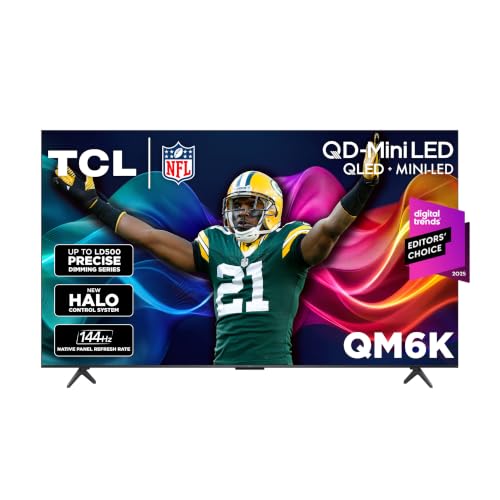
TCL 65QM6K
Best BudgetThe TCL 65QM6K is a QD-Mini LED TV. The listing describes high brightness, TCL's Halo Control System for local dimming, Dolby Vision, HDR10+, HDR10 and HLG, a 144Hz native refresh rate, and IMAX Enhanced certification. It runs Google TV.
It is the budget pick because it gets you a Mini-LED panel and quantum-dot color at the lowest tier in this list. Expect less peak brightness and fewer zones than the QM8L, so a room with a lot of direct sun can still wash it out, but for a typical living room with curtains or moderate window light it is a solid choice for streaming, sports and games.
- QD-Mini LED
- Halo Control System dimming
- 144Hz native, IMAX Enhanced
- Dolby Vision, HDR10+, Google TV
Pros: Mini-LED and quantum dots at a low tier, 144Hz, wide HDR support.
Cons: Lower brightness than the QM8L and U8QG; sound is basic.
Glossy or matte: what the screen surface does
A glossy screen shows deeper blacks but mirrors the room. A matte or anti-reflective layer scatters reflections so they are less distracting, at the cost of a little black depth. In a bright room, the scatter wins. If a TV does not list an anti-glare or anti-reflection layer, assume it will reflect more and place it so that windows are to the side of the screen, not behind you.
Placement matters as much as the TV
Put the TV on a wall perpendicular to the main window, not directly across from one. Hang curtains that you can close for movies. A 65 inch TV with good placement will beat an 85 inch TV with a window reflecting in the middle of the picture. Our room dimensions guide covers where the screen and seats sit in a room of any shape.
Pair it with sound
Bright living rooms are usually multipurpose rooms, so a soundbar is the natural partner. See our best soundbars guide, or build up to a full surround system with the best home theater receivers.
TV or projector for a bright room
A TV is the easy answer, because it works with the lights on. A projector needs dimmer conditions or an ambient light rejecting screen, which is covered in our best projector screens guide. For the numbers, run both through TV vs projector.