The LG C4 65-inch OLED (under $2,500) is the best TV for a home theater: perfect blacks, Dolby Vision and four HDMI 2.1 ports. In a room you cannot fully darken, the Hisense U8 Mini-LED (under $2,500) is the better buy, the Sony A95L QD-OLED (over $2,500) is the premium pick, and the TCL Q6 65-inch QLED (under $1,000) is the value choice.
Updated 2026
Quick answer
The LG C4 65" OLED is the best TV for home theater at under $2,500, pairing perfect OLED blacks with 1,000 nits peak brightness, Dolby Vision, and four HDMI 2.1 ports. In a room you cannot fully darken, the Hisense U8 at under $2,500 is the better buy: Hisense rates it at up to 5,000 nits with Anti-Reflection Pro, so highlights survive daylight. Size it with the screen size calculator.
🔗 Feed the new TV properly: see the best streaming devices for home theater, our Roku Ultra vs Apple TV 4K comparison, and the best 4K Blu-ray players.
This is the decision that actually determines how good your home theater looks, and it is settled by one thing: how much light you can remove from the room. Screen size, processor branding and smart platform are all secondary. Measure your room against these three cases before you compare models.
| Your room | Buy this panel | Why | Pick |
|---|---|---|---|
| Fully dark no windows, or full blackout |
OLED or QD-OLED | Pixels switch off entirely, so letterbox bars disappear and shadow detail survives. Nothing backlit matches this in the dark. | LG C4 or Sony A95L |
| Some ambient light windows with blinds, evening use |
Mini-LED | Ambient light raises the black floor on any panel, so the winner becomes whichever set puts out more highlight brightness and reflects less. | Hisense U8 |
| Bright, multi-use room daytime viewing, no light control |
Mini-LED with an anti-glare layer | Reflection control matters as much as output here. A glossy OLED will mirror the window behind you no matter how good its contrast is. | Hisense U8 or Samsung QN70H |
Two qualifiers worth knowing before you commit. First, QLED on its own is a colour technology, not a contrast one: a QLED without Mini-LED or a high-zone-count local dimming system will not control contrast like the sets above, which is the honest limit of the TCL Q6 at its price. Second, Samsung does not support Dolby Vision on any of its TVs, so if your library leans on Dolby Vision masters, that rules the QN70H out before brightness enters the argument.
⚖️ Compare two top picks: TCL Q7 vs Hisense U8N.
⚖️ Deciding between two top picks? See our head-to-head: Sony A95L vs LG C4.
⚖️ Deciding between the top two? See our head-to-head: LG C4 vs Hisense U8N.
The television is the centerpiece of any home theater system. It is the component you look at for every second of every movie, show, and game. While speakers, receivers, and room treatment all matter enormously, the display determines the fundamental quality of the visual experience in ways that no other component can compensate for. A mediocre TV paired with a world-class audio system still delivers a mediocre picture. A great TV paired with even a modest soundbar still delivers stunning visuals that draw you into the content. For anyone building or upgrading a home theater, the TV deserves the largest share of your budget.
The TV market in 2026 offers more genuine variety than ever before. OLED panels from LG and Sony deliver perfect blacks and infinite contrast that make them the gold standard for dark room home theaters. QD-OLED technology from Samsung Display, used in the Sony A95L, combines OLED's perfect blacks with quantum dot color volume for the most vibrant, accurate picture available. Mini-LED backlighting has matured dramatically, with panels from Hisense and Samsung now offering thousands of dimming zones that approach OLED-level contrast at significantly lower prices. Even budget QLED panels from TCL deliver HDR performance that would have been flagship-tier just three years ago. The result is that every budget level now has a genuinely excellent option for home theater use.
We researched each TV in this guide against manufacturer specifications, professional calibration reviews, and verified owner reports, drawing on published measurements from 4K Blu-rays, Dolby Vision streaming content, and HDR gaming. We looked at peak brightness, black levels, color accuracy, motion handling, HDR tone mapping, and input lag. We also assessed each TV's smart platform, HDMI connectivity, audio return channel support, and overall build quality. Every recommendation reflects documented real-world performance in the environment where these TVs will actually be used: a room optimized for watching movies and shows at their absolute best.
Use our calculators to determine the ideal screen size for your viewing distance and compare TVs against projectors for your space.
Selecting the right TV for a home theater is different from choosing one for a living room or bedroom. The features that matter most are the ones that directly affect picture quality in a controlled viewing environment with optimized lighting. Here is what to prioritize and why each specification matters for a dedicated theater setup.
OLED panels produce perfect blacks by turning off individual pixels, delivering infinite contrast ratio and zero blooming around bright objects on dark backgrounds. This makes OLED the top choice for dark, light-controlled home theaters where black level performance is paramount. QD-OLED adds quantum dots to the OLED structure for wider color volume and higher brightness. Mini-LED uses thousands of tiny LED backlights with local dimming to achieve deep blacks and very high peak brightness, often exceeding 2,000 nits. Mini-LED is the best option for rooms with some ambient light or for viewers who want maximum HDR punch.
QLED is a marketing term for LED-backlit LCD panels with quantum dot enhancement for wider color gamut. Budget QLED TVs use fewer dimming zones than Mini-LED, which means less precise contrast control. However, the best QLED panels still deliver excellent HDR performance and vibrant color at price points significantly below OLED. For home theaters where budget is a primary concern, a quality QLED or Mini-LED TV outperforms an entry-level OLED at the same price point. Consider your room's lighting conditions and whether you are comparing a projector or a TV for your theater before deciding on panel type.
High Dynamic Range is the single biggest improvement in picture quality over the past decade, delivering brighter highlights, deeper blacks, and a wider color palette compared to standard dynamic range content. The key HDR formats are Dolby Vision (dynamic metadata, scene-by-scene optimization), HDR10 (static metadata, universal baseline), HDR10+ (Samsung's dynamic metadata format), and HLG (Hybrid Log-Gamma for broadcast content). Dolby Vision is the most important format to support because it has the widest content library across Netflix, Disney+, Apple TV+, and 4K Blu-ray discs.
A TV's HDR performance depends not just on format support but on the panel's ability to display HDR content as intended. Peak brightness determines how impactful HDR highlights appear. A nit is the unit of display brightness equal to one candela per square meter, so a 2,000 nit Mini-LED panel can render HDR highlights roughly twice as bright as a 1,000 nit OLED. An OLED TV hitting 1,000 nits creates stunning specular highlights against its perfect blacks, while a Mini-LED TV reaching 2,500 nits can produce even more intense highlights but with slightly elevated black levels. The ideal home theater TV supports all four HDR formats and has enough brightness and contrast to render the full dynamic range of mastered content. Pair your TV with a capable streaming device that passes through the correct HDR format for the best results.
HDMI 2.1 provides 48 Gbps bandwidth, supporting 4K at 120Hz, 8K at 60Hz, Variable Refresh Rate (VRR), Auto Low Latency Mode (ALLM), and enhanced Audio Return Channel (eARC). For home theater use, eARC is the most critical HDMI 2.1 feature because it enables lossless Dolby TrueHD and DTS:X audio passthrough from the TV to your AV receiver or soundbar. Without eARC, you are limited to lossy compressed audio over standard ARC.
The number of HDMI 2.1 ports matters if you connect multiple high-bandwidth devices such as a PlayStation 5, Xbox Series X, 4K Blu-ray player, and streaming device. Some TVs offer four full HDMI 2.1 ports while others provide only one or two, with the remaining ports limited to HDMI 2.0. Check how many HDMI 2.1 ports a TV offers before purchasing, especially if gaming is part of your home theater use case. VRR eliminates screen tearing during gaming, and ALLM automatically switches to the TV's lowest-latency picture mode when a game console is detected. Input lag is the delay between a console sending a frame and the TV putting it on screen, which is why a game mode figure under 10 milliseconds matters for fast action and is irrelevant for movie watching.
Every modern TV includes a built-in smart platform, but quality varies significantly. LG webOS is clean and responsive with full Dolby Vision and Atmos support across all major apps. Google TV (used by Sony, Hisense, and TCL) offers the broadest app selection and excellent content aggregation. Samsung Tizen is fast and polished but lacks native Dolby Vision support from some apps. For the best experience, consider pairing your TV with a dedicated streaming device regardless of the built-in platform.
Audio output capabilities determine how well your TV integrates with external sound systems. eARC support is essential for passing lossless audio to your receiver. Some TVs also support Dolby Atmos decoding through their built-in speakers, which while not a substitute for a proper surround system, adds a degree of spatial audio for casual viewing. Check that the TV's eARC implementation actually passes through all audio formats and not just a subset. For a complete home theater audio chain, see our soundbar guide or receiver guide.
We researched every TV against manufacturer specifications, professional calibration reviews, and verified owner reports, looking at real-world picture quality, HDR performance, and overall value. These six TVs represent the best options for every budget and room type in 2026.
| Category | TV | Key Feature | Budget |
|---|---|---|---|
| Best Overall | LG C4 65" OLED | Perfect blacks, Dolby Vision, 4x HDMI 2.1 | Under $2,500 |
| Best Premium | Sony A95L 65" QD-OLED | Best color accuracy, QD-OLED, XR processor | $2,500+ |
| Best for Bright Rooms | Hisense U8 65" Mini-LED | Up to 5,000 nits, up to 5,600 dimming zones | Under $2,500 |
| Best Budget | TCL Q6 65" QLED | Direct-lit QLED, Dolby Vision, HDR10+, 120Hz | Under $1,000 |
| Best Mini-LED Value | Samsung QN70H 65" Neo QLED | Quantum Mini LED, 100% color volume, NQ4 AI | Under $2,500 |
| Best 85"+ | Sony X90L 85" | XR processor, full-array LED, Dolby Vision | Under $2,500 |
The table above lists the best TV in each category with its standout feature and price, and the spread runs from the under-$1,000 TCL Q6 to the $2,500-plus Sony A95L.
The LG C4 is the best overall TV for home theater in 2026, delivering the combination of picture quality, features, and value that makes it the default recommendation for most buyers. Its OLED Evo panel produces perfect blacks with zero light bleed, infinite contrast ratio, and wide viewing angles that look equally stunning from every seat in a multi-row theater setup. The Alpha 9 Gen 7 processor handles tone mapping, upscaling, and motion processing with sophistication that extracts the most from every source, whether you are watching a pristine 4K Dolby Vision Blu-ray or upscaling older 1080p content. In a light-controlled home theater room, the C4's black level performance is transformative, making letterbox bars truly invisible and giving dark scenes a depth and dimensionality that LED-based panels simply cannot replicate.
HDR performance on the C4 is outstanding for an OLED. Peak brightness reaches approximately 1,000 nits on a 10% window in Dolby Vision mode, which is enough to produce eye-catching specular highlights that pop against the panel's perfect blacks. The TV supports the full suite of HDR formats: Dolby Vision, HDR10, HLG, and Dolby Vision IQ, which adjusts tone mapping based on ambient light conditions detected by the built-in light sensor. Color accuracy out of the box is excellent and improves further with calibration, covering over 98% of the DCI-P3 color space that mastering studios use for HDR content. The webOS smart platform is clean and responsive, with native support for every major streaming service in full Dolby Vision and Dolby Atmos. Audio return is handled through eARC on one of the four HDMI 2.1 ports, enabling lossless audio passthrough to your AV receiver or soundbar.
For gaming, the C4 is equally impressive with four HDMI 2.1 ports supporting 4K at 120Hz, VRR (FreeSync Premium and G-Sync compatible), ALLM, and Dolby Vision gaming. Input lag in Game Mode is under 10 milliseconds, and the near-instant pixel response time of OLED eliminates motion blur entirely. This makes the C4 an exceptional dual-purpose display for home theaters that also serve as gaming rooms. The only limitation compared to higher-end Mini-LED panels is absolute peak brightness in HDR. If your theater room has significant ambient light, the Samsung QN70H or Hisense U8 may produce a more impactful HDR image. But for the majority of home theaters with controlled lighting, the LG C4's combination of perfect blacks, exceptional color, and comprehensive features makes it the TV to beat.
The Sony A95L is the finest television you can put in a home theater in 2026. Its QD-OLED panel, manufactured by Samsung Display and exclusively tuned by Sony, combines the perfect blacks and infinite contrast of OLED with the quantum dot color enhancement that produces wider color volume and higher peak brightness than traditional WOLED panels. The result is a picture that is simultaneously the most accurate and the most visually stunning you can get from any consumer display. Colors are richer and more saturated without ever appearing oversaturated, thanks to Sony's Cognitive Processor XR, which analyzes the image the way a human eye perceives it, applying intelligent tone mapping, upscaling, and motion processing that consistently produces the most natural, film-like image of any TV on the market.
Peak brightness on the A95L reaches approximately 1,500 nits on small highlights, a significant advantage over standard WOLED panels and enough to make HDR content genuinely dazzling. Dolby Vision content looks spectacular, with the XR processor's tone mapping extracting every bit of dynamic range from the source material. The TV also supports HLG for broadcast HDR content. Color accuracy is reference-grade, covering virtually 100% of the DCI-P3 gamut with Delta E values under 1.5 in the calibrated Filmmaker Mode, which means the A95L displays colors exactly as the director and colorist intended. For cinephiles and home theater enthusiasts who consider accurate color reproduction the highest priority, no other TV comes close. The Google TV platform provides access to all major streaming apps with native Dolby Vision and Atmos support, and the interface is fast and intuitive.
The A95L features two HDMI 2.1 ports supporting 4K 120Hz with VRR and ALLM for gaming, plus eARC for lossless audio passthrough. Sony's Acoustic Surface Audio+ technology turns the screen itself into a speaker, creating sound that appears to emanate directly from the characters and objects on screen. While this built-in audio is impressive for a TV, a dedicated home theater system with a proper receiver and speaker system still far surpasses it. The premium price of over $2,500 for the 65-inch model is significant, and the LG C4 delivers 90% of the picture quality for roughly half the price. But for anyone who wants the absolute best picture quality available for their dedicated home theater, the Sony A95L is the uncompromising choice that rewards close viewing with every frame.
The Hisense U8 is the TV to buy when your theater room has windows, a doorway to a bright kitchen, or any light you cannot fully kill. Hisense specifies the MiniLED Pro backlight at up to 5,000 nits peak brightness across up to 5,600 local dimming zones, and adds an Anti-Reflection Pro layer that puts the anti-glare coating inside the liquid crystal layer rather than on top of it. Those two things together are what a bright room actually needs: enough output that HDR highlights still read as highlights, and a screen that does not hand you a mirror image of the window behind you. An OLED in the same room will look flat by comparison, not because its panel is worse but because ambient light raises its black floor while its highlights stay put.
The U8 carries the dynamic HDR formats that matter, HDR10+ and Dolby Vision IQ, so you get scene-by-scene tone mapping on both the Samsung-aligned and Dolby-aligned catalogues, plus Dolby Atmos and IMAX Enhanced. Hisense pairs it with a 4.1.2 channel speaker array, which is more capable than the usual flat-panel pair but is still not a substitute for a real system: send it out over eARC to a receiver or soundbar. Processing is handled by the Hi-View AI Engine Pro, which adjusts picture and sound to the content rather than to a fixed profile.
For a room that doubles as a gaming space the U8 is unusually well equipped for the money: a native 165Hz panel with a variable refresh rate range of 48Hz to 165Hz, AMD FreeSync Premium Pro, Game Booster 288, and an Enhanced Game Bar for monitoring frame rate and VRR state while you play. The trade-off against OLED is the one every backlit panel makes. In a genuinely dark room, dimming zones are larger than pixels, so a bright object on a black field still shows some bloom, and the LG C4 will look cleaner. Pick the U8 when light control is the problem you are solving, and the C4 when it is not.
The TCL Q6 is the honest answer to "how little can I spend and still have a real home theater picture." At under $1,000 for 65 inches it brings quantum dot colour with TCL's UltraWide Color Gamut and the full set of HDR formats under the HDR PRO+ banner: Dolby Vision, HDR10, HDR10+ and HLG. That format list matters more at this price than any single specification, because it means the Q6 will take the best stream a service offers rather than falling back to basic HDR10 on half your library.
Be clear about what the backlight is, because this is where budget sets are usually oversold. The Q6 uses a HighBright Direct LED backlight, not Mini-LED and not a high-zone-count full-array system. Direct-lit means the LEDs sit behind the panel rather than around its edge, which gives more even brightness than an edge-lit set, but contrast control is coarse next to the Hisense U8. In a dark theater you will see the black floor lift in letterbox bars. In a normally lit family room you mostly will not. Judge it on that basis and it is a lot of television for the money.
Gaming is better served than the price suggests. Game Accelerator 120 gives a 120Hz mode with AMD FreeSync variable refresh rate, and Motion Rate 240 with MEMC frame insertion smooths fast motion, though you should switch MEMC off for films to avoid the soap opera effect. The platform is Google TV with Chromecast built in and a voice remote that works with Alexa. eARC passes audio out to your receiver or soundbar, which is exactly where the money you saved on the panel should go: a $555 TV with a $400 soundbar beats a $950 TV with built-in speakers in almost every room.
The QN70H is Samsung's entry into Neo QLED, which is Samsung's name for a Mini-LED backlight. The Quantum Mini LEDs are physically smaller than conventional backlight LEDs, so they can be packed more densely and switched in finer groups, which is what lifts contrast in dark scenes and keeps bright scenes from washing out. Samsung rates the panel at 100% colour volume with Quantum Dot, meaning it holds its colour saturation as brightness rises instead of desaturating toward white in the highlights, and the NQ4 AI Processor handles upscaling and Color Booster Pro colour work.
The one thing to understand before buying any Samsung for a theater room is Dolby Vision. Samsung does not support it, on this set or any other, and backs HDR10+ instead. Most streaming services carry a Dolby Vision master and an HDR10 fallback, so on a Samsung you will often be watching the HDR10 version of a title that a C4 or U8 would show in Dolby Vision. Amazon Prime Video is the main service that carries HDR10+ broadly. Whether that matters is a genuine judgement call rather than a defect, but it is the reason this set sits below the OLEDs in a dedicated dark room ranking.
Where the QN70H earns its place is price per unit of Mini-LED. At under $2,500 it undercuts most Mini-LED sets while keeping the backlight technology that makes the category worth buying, and Tizen remains one of the faster, better organised smart platforms. Samsung does not publish a peak brightness figure, a refresh rate or an HDMI 2.1 port count for this series, so confirm those on the listing for the exact size you buy rather than assuming they match the flagship models. If maximum stated brightness is the priority, the Hisense U8 publishes its numbers and they are high.
The Sony X90L 85-inch is the best choice for home theater builders who want a truly massive screen without the cost and complexity of a projector setup. At 85 inches, the X90L creates a genuinely immersive viewing experience that fills your field of vision from standard home theater seating distances of 9 to 12 feet. Sony's Cognitive Processor XR, the same processor found in their premium OLED and Mini-LED models, provides industry-leading upscaling, tone mapping, and motion processing that makes the most of the panel's capabilities. The XR processor is particularly impressive at upscaling 1080p content to 4K, applying intelligent detail enhancement and noise reduction that keeps the image clean and sharp even on an 85-inch screen where upscaling artifacts are more visible than on smaller panels.
The full-array LED backlight with local dimming provides good contrast for an LED-based panel, with deep blacks in dark scenes and respectable HDR highlights. Peak brightness reaches approximately 1,000 nits, which is adequate for an impactful HDR presentation in a light-controlled theater room. The TV supports Dolby Vision, HDR10, and HLG, covering the most important HDR formats for streaming and disc-based content. Sony's Triluminos Pro display technology delivers wide color gamut coverage with natural, accurate color reproduction that is distinctly Sony, prioritizing accuracy and natural skin tones over the oversaturated pop that some competitors favor. The Google TV platform provides full access to all streaming apps with native Dolby Vision and Atmos support, and the interface is responsive despite the processing demands of the 85-inch panel.
The X90L includes two HDMI 2.1 ports supporting 4K at 120Hz with VRR and ALLM for gaming, plus two HDMI 2.0 ports and eARC for lossless audio passthrough to your receiver. At under $2,500 for the 85-inch model, it costs less than most 65-inch OLED TVs while providing a dramatically larger viewing area. The trade-off is that LED-based panels at this size show more visible blooming and less precise local dimming compared to smaller Mini-LED models with higher zone counts. For a completely dark home theater room where absolute black levels are the top priority, a 65-inch OLED like the LG C4 or a projector may be a better fit. But for viewers who prioritize screen size and want an immersive, cinema-scale experience from a flat panel without a projector, the Sony X90L 85-inch delivers exceptional value and Sony's best-in-class image processing in a screen that truly fills a room.
This side-by-side comparison shows the key specifications that matter most for home theater use. Use this table to quickly identify which TV matches your requirements for panel technology, HDR formats, brightness, and connectivity. For help choosing between a TV and a projector for your space, see our projector vs TV comparison guide.
| Feature | LG C4 | Sony A95L | Hisense U8 | TCL Q6 | Samsung QN70H | Sony X90L |
|---|---|---|---|---|---|---|
| Price (65") | Under $2,500 | $2,500+ | Under $2,500 | Under $1,000 | Under $2,500 | Under $2,500 (85") |
| Panel Type | OLED Evo | QD-OLED | Mini-LED | QLED | Neo QLED Mini-LED | Full-array LED |
| Dolby Vision | Yes | Yes | Yes | Yes | No | Yes |
| HDR10+ | No | No | Yes | Yes | Yes | No |
| Peak Brightness (as published) | ~1,000 nits | ~1,500 nits | Up to 5,000 nits | Not published | Not published | ~1,000 nits |
| Refresh Rate | 144Hz | 120Hz | Native 165Hz | 120Hz (Game Accelerator) | Not published | 120Hz |
| HDMI 2.1 Ports | 4 | 2 | Not published | Not published | Not published | 2 |
| VRR / ALLM | Yes / Yes | Yes / Yes | Yes / Yes | Yes / Yes | Yes / Yes | Yes / Yes |
| Smart TV OS | webOS 24 | Google TV | Google TV | Google TV | Tizen | Google TV |
| eARC | Yes | Yes | Yes | Yes | Yes | Yes |
The table above compares all six TVs on price, panel type, HDR format support, peak brightness, refresh rate, HDMI 2.1 port count, and eARC, and the brightness leader is the Hisense U8, which Hisense rates at up to 5,000 nits. Where a cell reads "not published", the manufacturer does not state that figure for this series, so confirm it on the listing for the exact size you buy.
Whichever panel you chose above, two purchases do more for the finished room than moving up a TV tier would. Getting the screen to seated eye level fixes the geometry that makes a theater feel like a theater, and getting the sound off the panel fixes the one weakness every flat TV shares: there is no cabinet volume behind a screen that thin, so dialogue and bass both suffer no matter what you spent.
UL Listed, fits 42 to 90 inch TVs up to 132 lbs. Full motion is the one to buy if the seating is off to one side or the wall is not square to the room.
Under $100
Check price on Amazon
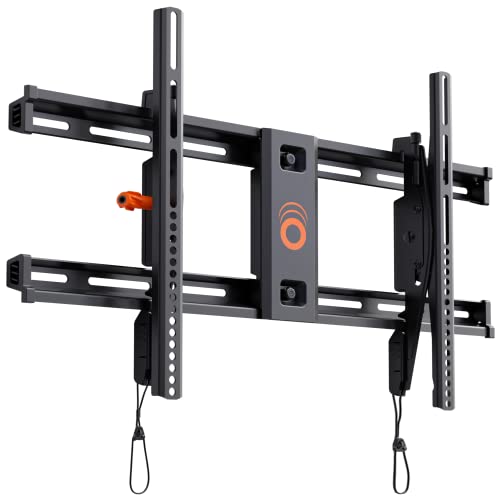
Fits 40 to 90 inch TVs up to 135 lbs with 10 degrees of tilt. The cheaper, lower-profile choice when the TV sits slightly high and you only need to angle it down.
Under $50
Check price on Amazon
2.1 channels with a wireless subwoofer, Dolby Atmos and DTS:X. The minimum upgrade that gives you real bass under the picture rather than thin panel audio.
Under $250
Check price on Amazon
5.1 channels with Dolby Atmos and MultiBeam 3.0. Worth the step up in a dedicated room where you want surround effects without running speaker wire.
Under $500
Check price on AmazonMount height is the part people get wrong. Put the centre of the screen at seated eye level, usually 42 to 48 inches from the floor for a normal sofa, not at standing eye level. If you would rather run real speakers than a soundbar, our receiver guide and speaker system guide cover that route.
Panel technology is the most consequential decision when choosing a home theater TV. Each technology has distinct strengths and weaknesses that make it better suited to specific room conditions and viewing habits. Understanding these differences will help you choose the right panel type for your home theater setup before you compare individual models.
OLED panels use self-emitting organic compounds that produce light at the individual pixel level. When a pixel needs to be black, it turns off completely, producing true zero-nit black that no backlit technology can match. This results in infinite contrast ratio, the single most important factor in perceived picture quality. In a light-controlled home theater, OLED delivers the most cinematic image with perfectly invisible letterbox bars, exceptional shadow detail, and HDR highlights that pop dramatically against pure black backgrounds.
The trade-offs are lower peak brightness compared to Mini-LED, potential burn-in risk from prolonged static content display, and higher cost per inch. Modern OLED panels have largely mitigated burn-in through pixel shifting, automatic brightness limiters, and panel refresh cycles. For a dedicated movie-watching home theater, OLED remains the premier choice. The LG C4 and Sony A95L represent the current state of the art in OLED and QD-OLED technology respectively. Our LG C4 OLED review goes deeper on its brightness ceiling, gaming features, and out-of-box calibration.
Mini-LED uses thousands of tiny LED backlights grouped into hundreds or thousands of individually controlled dimming zones behind an LCD panel. This allows dramatically higher peak brightness than OLED, often exceeding 2,000 nits, while providing much more precise contrast control than conventional LED backlighting. The result is an HDR image that is strikingly vivid with specular highlights that carry genuine visual punch, making Mini-LED the superior choice for rooms with ambient light.
The limitation of Mini-LED is blooming, a halo of light visible around bright objects on dark backgrounds caused by the fact that dimming zones are larger than individual pixels. Modern Mini-LED panels with high zone counts minimize this effect, but in a perfectly dark room, blooming is visible when directly compared to OLED. The Hisense U8 and Samsung QN70H represent the best of Mini-LED technology, offering exceptional brightness and increasingly precise local dimming at prices well below OLED.
QLED is Samsung's branding for LED-backlit LCD panels enhanced with quantum dots for wider color gamut. Budget QLED TVs use fewer dimming zones than Mini-LED, with some using edge-lit or direct-lit backlighting without true local dimming. This means less precise contrast control and more visible light bleed in dark scenes. However, quantum dot enhancement delivers excellent color saturation and wide gamut coverage that approaches Mini-LED performance at a fraction of the cost.
For home theaters on a tight budget, a quality QLED TV like the TCL Q6 delivers a vastly better experience than a basic LED TV without quantum dots. The key is to look for models with full-array local dimming rather than edge-lit designs, which offer better contrast and more uniform brightness. QLED is the right choice when your priority is maximizing screen size and overall capability within a limited budget, leaving room for essential audio upgrades.
QD-OLED combines the self-emitting pixel structure of OLED with a quantum dot color conversion layer, replacing the white OLED with blue subpixels and red and green quantum dot conversion. The result is OLED's perfect blacks and infinite contrast paired with wider color volume and higher peak brightness than traditional WOLED panels. QD-OLED produces the most vibrant, saturated colors of any panel technology while maintaining the natural color accuracy that OLED is known for.
The Sony A95L is the premier QD-OLED TV, reaching approximately 1,500 nits peak brightness while maintaining perfect blacks. The trade-off is premium pricing. QD-OLED panels are currently available only in 55-inch and 65-inch sizes, limiting options for larger home theaters. For viewers who demand the absolute best picture quality regardless of price and room size constraints, QD-OLED represents the current pinnacle of consumer display technology.
Getting the most from your home theater TV requires proper calibration, correct HDMI configuration, and a few adjustments that manufacturers do not enable by default. These setup tips apply to all TV technologies and will ensure you are getting the best possible picture quality from your home theater system. It is also worth running the TV and its source components through a home theater surge protector so a single grid surge cannot take out the whole chain.
Filmmaker Mode or Cinema Mode is the correct starting point for home theater use. These modes disable motion smoothing (the soap opera effect), set the color temperature to the industry-standard D65 warm white, and preserve the original frame rate and aspect ratio of the content. Avoid Vivid, Dynamic, or Standard modes, which boost brightness and color saturation artificially, producing an eye-catching showroom image that is inaccurate and fatiguing during long viewing sessions.
On LG TVs, use Cinema or Filmmaker Mode. On Sony, use Custom or Cinema. On Samsung, use Filmmaker Mode or Movie. On Hisense and TCL, use Filmmaker Mode or Movie. After selecting the correct mode, you can fine-tune brightness, contrast, and backlight level to suit your room. Professional calibration with a colorimeter can further improve accuracy, but the out-of-box Cinema/Filmmaker modes on modern TVs are already remarkably accurate.
Enable Enhanced HDMI mode on every HDMI port you use. Most TVs ship with HDMI ports in a compatibility mode that limits bandwidth and disables HDR. On LG, enable HDMI ULTRA HD Deep Color. On Samsung, enable Input Signal Plus. On Sony, set HDMI signal format to Enhanced. On Hisense and TCL, set HDMI Mode to HDMI 2.0 or Enhanced. Without this setting, your sources may output SDR even when playing Dolby Vision content.
Configure eARC for audio passthrough. Connect your AV receiver or soundbar to the TV's eARC-labeled HDMI port (typically HDMI 2 or HDMI 3). Enable eARC in the TV's audio settings and set audio output to Passthrough or Bitstream. This ensures lossless Dolby TrueHD and DTS:X audio from your sources is passed through to your audio system without being downmixed by the TV. Use a certified Ultra High Speed HDMI cable for all connections.
Motion interpolation, commonly called the soap opera effect, is enabled by default on most TVs and is the single most disliked picture processing feature among movie enthusiasts. It inserts artificially generated frames between the original frames, turning the cinematic 24fps motion cadence of films into a hyper-smooth video look that destroys the filmic quality directors intend. For home theater use, this feature should always be disabled.
On LG, set TruMotion to Off or Cinema Clear. On Sony, set Motionflow to Off. On Samsung, set Motion Smoothing or Auto Motion Plus to Off. On Hisense, set Motion Enhancement to Off. On TCL, set Action Smoothing to Off. Filmmaker Mode automatically disables motion smoothing on all brands, which is another reason it is the recommended starting picture mode for home theater use.
Light control is the most impactful and least expensive upgrade you can make to improve your home theater TV's picture quality. Even a $500 TV looks dramatically better in a dark room than a $2,000 TV in a bright room. Blackout curtains, bias lighting behind the TV, and dimmable overhead lights all contribute to a better viewing experience. Bias lighting, a strip of neutral white LED light placed behind the TV, reduces eye strain and makes perceived contrast appear deeper by providing a dim reference point for your eyes.
TV placement should position the center of the screen at seated eye level, typically 42 to 48 inches from the floor for standard sofa seating. Wall mounting at the correct height eliminates the reflections that a TV stand can introduce and creates a cleaner, more theater-like presentation. Avoid placing the TV opposite a window or under direct overhead lighting, as these create reflections and reduce perceived contrast even on anti-reflective screens. For viewing distance recommendations based on your screen size, use our screen size calculator.
Researched from published specifications and standards, not hands-on testing. Not professional installation advice. Prices change often.
The TCL Q6 65-inch QLED (under $1,000) is the budget pick with Dolby Vision, HDR10+ and 120Hz. Stepping up, the Samsung QN70H 65-inch Mini-LED (under $2,500) adds far better brightness and dimming, and the Sony X90L 85-inch (under $2,500) is the value way to go really big.
The Sony A95L 65-inch (over $2,500) is our QD-OLED pick: OLED-level blacks with brighter, more saturated color than a standard WOLED panel, which suits dark theater rooms with HDR movies. The LG C4 OLED gets most of the way there for less than half the price.
Yes, as the value option. A QLED like the TCL Q6 gets you a big, bright 65-inch picture with Dolby Vision for under $1,000, but its blacks cannot match OLED in a dark room. If the theater is fully dark, OLED is worth the step up; if it has windows, a Mini-LED QLED is the stronger choice.
OLED is the superior choice for a dedicated dark home theater room. OLED panels produce perfect blacks by turning off individual pixels completely, resulting in infinite contrast ratio with no blooming or light bleed around bright objects. In a light-controlled theater environment, this translates to a dramatically more cinematic image with inky black letterbox bars, vivid HDR highlights that pop against true black backgrounds, and exceptional shadow detail. LED and Mini-LED TVs use local dimming zones to approximate deep blacks, but they cannot match the pixel-level precision of OLED. The LG C4 OLED and Sony A95L QD-OLED are both outstanding choices for dark room home theaters.
The ideal TV size depends on your seating distance. For a cinematic home theater experience, the Society of Motion Picture and Television Engineers recommends a viewing angle of about 30 degrees, which translates to sitting roughly 1.2 to 1.6 times the screen diagonal away from the TV. For a 65-inch TV, the optimal viewing distance is approximately 6.5 to 8.5 feet. For a 75-inch TV, aim for 7.5 to 10 feet. For an 85-inch TV, 8.5 to 11 feet works well. If your seating distance is greater than 10 feet, consider a 75-inch or larger TV, or explore a projector setup for a truly immersive experience. Use our screen size calculator to find the exact recommendation for your room.
HDMI 2.1 is essential if you plan to use your home theater TV for gaming at 4K 120Hz, as it provides the 48 Gbps bandwidth required for high frame rate 4K content. For movie watching, HDMI 2.1 is less critical since films are mastered at 24fps and streaming content tops out at 4K 60fps, both well within HDMI 2.0 bandwidth limits. However, HDMI 2.1 also brings eARC for lossless audio passthrough to soundbars and receivers, VRR for tear-free gaming, and ALLM for automatic low latency mode. Port counts vary by series and by screen size and several manufacturers do not publish them, so confirm the HDMI 2.1 port count on the listing for the exact size you are buying. Use certified Ultra High Speed HDMI cables to ensure full bandwidth.
Both Dolby Vision and HDR10+ are dynamic HDR formats that adjust brightness and color metadata scene by scene for optimal picture quality. Dolby Vision supports up to 10,000 nits peak brightness and 12-bit color depth, while HDR10+ supports up to 4,000 nits and 10-bit color. Dolby Vision has significantly broader adoption, with support from Netflix, Disney+, Apple TV+, and most major streaming services. HDR10+ is primarily supported by Amazon Prime Video and some Samsung-partnered content. For home theater use, Dolby Vision support is more important due to the wider content library. Ideally, choose a TV that supports both formats for maximum compatibility, such as the Hisense U8 or TCL Q6.
Yes, external audio is strongly recommended for any home theater setup. Even premium TVs have thin cabinets that physically cannot house speakers large enough to produce full, immersive sound. Built-in TV speakers typically lack bass response below 80-100Hz, have limited dynamic range, and cannot create a convincing surround sound field. A quality soundbar with a wireless subwoofer is the minimum upgrade for home theater use, providing wider sound staging, actual bass response, and often Dolby Atmos support. For a dedicated theater room, a full surround sound system with an AV receiver and discrete speakers delivers a dramatically superior experience that transforms movie watching.
The LG C4 OLED is the best TV for gaming in a home theater. It features four HDMI 2.1 ports supporting 4K at 120Hz with VRR, ALLM, and Dolby Vision gaming. Its near-instant pixel response time eliminates motion blur, and input lag in game mode is under 10 milliseconds. The Hisense U8 is the stronger choice for a room with ambient light, with a native 165Hz panel, a 48Hz to 165Hz variable refresh rate range and AMD FreeSync Premium Pro. For budget gaming the TCL Q6 runs a 120Hz Game Accelerator mode with AMD FreeSync. All three support AMD FreeSync for tear-free gameplay.
OLED burn-in risk has been dramatically reduced in modern panels and is no longer a significant concern for typical home theater use. Current OLED TVs from LG and Sony include multiple burn-in prevention features including pixel shifting, automatic brightness limiting for static elements, screen savers, and pixel refresher cycles that run automatically when the TV is turned off. For movie and TV show watching, where the content is constantly changing, burn-in is essentially a non-issue. The risk increases only with prolonged display of static elements like news channel logos, video game HUDs, or desktop taskbars shown for thousands of cumulative hours. For a dedicated home theater used primarily for movies and shows, OLED burn-in should not be a deciding factor against choosing the LG C4 or Sony A95L.
The definitive comparison to help you decide between a projector and a TV for your home theater display, covering picture quality, cost, and room requirements.
The best soundbars for home theater ranked by audio quality, Dolby Atmos performance, and value for every budget and room size.
Our top AV receiver picks for every budget, from affordable 5.1 receivers to flagship 11.2 channel models with Dolby Atmos and DTS:X.
The best 4K streaming devices for home theater, ranked by video quality, audio format support, and app ecosystem.
The complete guide to building a home theater from scratch, covering room selection, equipment, wiring, and calibration.