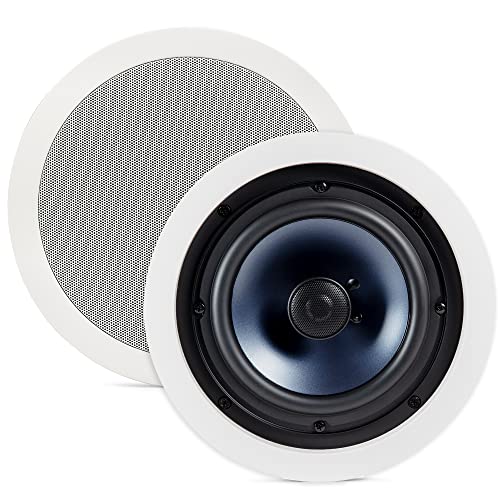
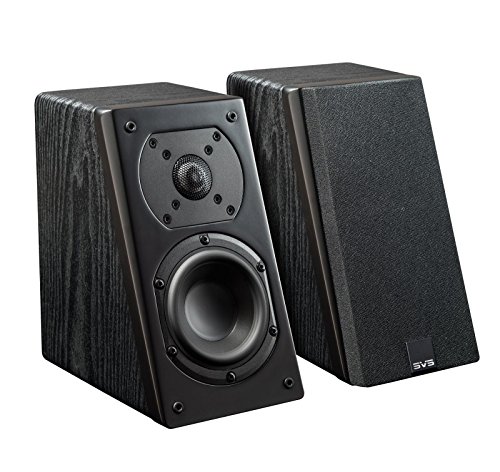
Place Atmos height speakers 30 to 55 degrees above your ears (45 degrees ideal), in line with or just inside your front left and right speakers. With a 9 foot ceiling and ears at 3.5 feet, that puts top front speakers about 5.5 feet in front of the seat and top rear speakers 5.5 feet behind it. Enter your room below for exact positions.
Updated 2026
Quick answer
Dolby wants height speakers at 30 to 55 degrees elevation from the seat, with 45 degrees ideal. At 45 degrees the horizontal offset equals the vertical one, so a 9 foot ceiling with ears 3.5 feet up puts the speakers 5.5 feet in front of and behind the seat, 6 to 10 feet apart.
🔗 Picking the speakers for these positions? See the best in-ceiling speakers for Dolby Atmos.
| Layout | Height speakers | Where the heights go | Receiver channels |
|---|---|---|---|
| 5.1.2 | 2 | Top middle: just in front of the main seat (65 to 100 degrees elevation), in line with the front L/R | 7 |
| 5.1.4 | 4 | Top front 30 to 55 degrees in front of the seat, top rear 30 to 55 degrees behind it | 9 |
| 7.1.4 | 4 | Same as 5.1.4, plus side and rear surrounds at ear level | 11 |
| 9.1.6 | 6 | Top front, top middle and top rear pairs | 15 (or processor plus external amps) |
Elevation angles follow the Dolby Atmos home theater installation guidelines. Measure from ear height at the main seat, not from the floor.
Enter your room dimensions and seating position to find the optimal height speaker placement for your Dolby Atmos system.
5.1.4 Atmos Speaker Positions
All speakers within Dolby recommended angles
Position: 4.5 feet in front of listening position
Elevation angle: 45° (Dolby spec: 30-55°)
Ceiling position: 7.5 feet from screen wall, 3 feet from side walls
Position: 4.5 feet behind listening position
Elevation angle: 45° (Dolby spec: 30-55°)
Ceiling position: 16.5 feet from screen wall, 3 feet from side walls
For in-ceiling speakers, aim drivers toward the listening position. For surface-mount speakers angled downward, position them slightly closer to the listening position.
Your 5.1.4 configuration requires a 9-channel AV receiver with Dolby Atmos decoding. Recommended: Denon AVR-X3900H or Marantz Cinema 60.
Want to keep this result?
Get this result plus the free printable home theater shopping list by email.
Free. No spam. Unsubscribe anytime.
Elevation angle is the angle upward from your ears to the speaker, measured from horizontal, so a speaker directly overhead sits at 90 degrees and one level with your ears at 0. If you only need that angle for a position you have already chosen, the Atmos angle calculator does that single calculation on its own.
The Dolby Atmos hub covers the configurations, height speaker types, and receiver channel counts that sit around these measurements.
Entry-level Atmos with 2 height speakers. Best positioned as Top Middle (above listening area) or Top Front. Requires 7-channel receiver. Great upgrade from 5.1 for overhead effects like rain and helicopters.
Full overhead soundstage with 4 height speakers: Top Front + Top Rear. Requires 9-channel receiver. Provides front-to-back overhead panning - the sweet spot for most home theaters.
Reference-level Atmos with 4 heights and dedicated rear surrounds. Requires 11-channel receiver. Best for larger rooms (15+ feet wide) where 7 ear-level speakers can be properly spaced.
Researched from published specifications and standards, not hands-on testing. Not professional installation advice. Prices change often.
Put the two top front speakers 30 to 55 degrees up and in front of the main seat, and the two top rear speakers 30 to 55 degrees up and behind it, each pair roughly in line with your front left and right speakers. Ear-level speakers stay in a normal 5.1 layout.
Exactly where they go in 5.1.4: two top front and two top rear in the ceiling at 30 to 55 degrees of elevation. The extra two channels are ear-level rear surrounds behind the seats, which is why 7.1.4 needs an 11-channel receiver and a room about 15 feet wide or more.
With only two heights, Dolby places them as top middle speakers: in the ceiling just in front of the main seat, 65 to 100 degrees of elevation, in line with the front left and right speakers. That gives overhead effects without a front-to-back gap.
Dolby recommends height speakers be placed at 30-55 degrees elevation from the listening position, with 45 degrees being ideal. This angle creates the most realistic overhead sound effects. To achieve this angle, ceiling speakers should be positioned approximately the same distance in front of (or behind) you as the ceiling is above your ears. For a 9-foot ceiling with seated ear height of 3.5 feet, that's 5.5 feet of vertical distance, so speakers should be about 5.5 feet in front of and behind your seat.
The three numbers represent: bed layer speakers (5 or 7), subwoofers (1), and height speakers (2 or 4). 5.1.2 has 5 ear-level speakers plus 2 ceiling speakers. 5.1.4 adds 2 more ceiling speakers for front-to-back overhead movement. 7.1.4 adds rear surround speakers to 5.1.4 for a more enveloping experience. For most rooms, 5.1.4 offers the best balance of immersion and practicality. 7.1.4 requires a larger room (15+ feet wide) to properly space seven ear-level speakers.
In-ceiling speakers provide the most accurate Atmos experience because sound comes directly from above. They require ceiling installation but offer precise object placement. Upfiring speakers are easier to install and bounce sound off the ceiling, but they're less precise and require a flat, reflective ceiling between 8-14 feet high. If you can install in-ceiling speakers, they're the better choice. If not, quality upfiring modules like the KEF R8a or Klipsch RP-500SA still deliver impressive immersion.
Atmos ceiling speakers should be separated to create a soundstage that matches or slightly exceeds your front L/R speaker spread. Typically this is 6-10 feet apart, matching your front speaker spacing. For a 14-foot wide room, ceiling speakers might be 8 feet apart, positioned about 3 feet from each side wall. The front and rear pairs should be symmetric, and all four height speakers should form a rectangle when viewed from above.
Yes, you can use regular bookshelf speakers mounted on the ceiling or high on walls, angled toward the listening position. Height channels don't need to reproduce deep bass (they're typically crossed over at 80-150Hz), so smaller speakers work fine. However, dedicated in-ceiling speakers are designed for the purpose with angled drivers that aim sound toward the listening area. If using regular speakers, ensure they're securely mounted and angled correctly - typically 30-45 degrees downward toward the main seat.
The receiver channels needed are: 5.1.2 requires 7 channels minimum (5+2), 5.1.4 requires 9 channels (5+4), and 7.1.4 requires 11 channels (7+4). Popular options include: Denon AVR-S770H (7.2ch, supports 5.1.2), Denon AVR-X3900H (9.4ch, supports 5.1.4 or 7.1.2), and Denon AVR-X6800H (11.4ch, supports 7.1.4). The receiver must support Dolby Atmos decoding - look for the Dolby Atmos logo. Most receivers from 2019 onward support Atmos.
For ceilings under 8 feet, achieving proper 30-55 degree angles is challenging. Options include: 1) Use upfiring Atmos modules instead of ceiling speakers - they work well with 8-foot ceilings. 2) Position ceiling speakers further from the listening position to reduce the elevation angle. 3) Use Atmos-enabled elevation speakers mounted high on the front and rear walls, angled downward. Minimum practical ceiling height for in-ceiling Atmos is about 7.5 feet. Below that, upfiring or wall-mounted height speakers are recommended.
Ideally, yes - all four height speakers should be identical for consistent timbre as sounds pan across the ceiling. At minimum, the front pair should match each other, and the rear pair should match each other. Mixing different speaker models or brands can cause audible tonal shifts as sounds move overhead, breaking immersion. If you're starting with 5.1.2 and plan to upgrade to 5.1.4 later, buy four matching speakers upfront and install two initially.
In-ceiling speakers require speaker wire run through your ceiling or attic to the speaker locations. Plan wire runs from your receiver location to each speaker position. Use at least 16-gauge speaker wire (14-gauge for runs over 50 feet). For new construction, install wire before drywall. For retrofit, you may need to fish wire through the ceiling - an attic makes this easier. Many in-ceiling speakers include dog-ear clamps that secure them to drywall without additional mounting hardware.
These are Dolby's two main height speaker configurations. Top Front/Top Rear (also called Top Middle for 2-speaker setups) are in-ceiling speakers positioned in front of and behind the listening position - this is the preferred Atmos layout. Front Height/Rear Height are wall-mounted speakers placed high on the front and rear walls, angled downward - this is an alternative when ceiling installation isn't possible. Both work with Atmos, but Top Front/Rear provides more convincing overhead effects.
Hand-picked height speakers for every budget. These are affiliate links - we may earn a commission at no extra cost to you.
5.25" in-ceiling speaker (sold each) with pivoting tweeter. Excellent directivity for precise Atmos placement. Easy installation with dog-ear clamps.
Budget-friendly 8" in-ceiling with swivel tweeter. Great value for Atmos height channels. Paintable grille blends with any ceiling.
Compact multi-purpose speaker perfect for wall or ceiling mounting. Versatile mounting options make it ideal for height channels on a budget.
Reference Premiere upfiring module. Tractrix horn-loaded design for dynamic Atmos effects. Matches RP-series speakers.
Versatile height speaker that works upfiring or wall-mounted. Compact design with excellent dispersion for flexible Atmos installations.
Budget-friendly Atmos-enabled speaker. Sits atop any bookshelf or tower speaker. Great entry point for height channels.
9.4 channel for 5.1.4 Atmos. Dirac Live ready, HDMI 2.1, and 8K passthrough. Best value for full Atmos experience.
7.2 channel entry-level Atmos receiver. Supports 5.1.2 configuration. HDMI 2.1 and Audyssey room correction included.
7.2 channel premium Atmos receiver. Audiophile-grade amplification with HDAM circuits. Elegant design and build quality.
As an Amazon Associate, we earn from qualifying purchases. Prices may vary.
Planning speakers? Use the home theater speaker placement calculator for exact 5.1 and 7.1 positions in your room.