Surround Sound Speaker Placement: 5.1, 7.1 & 7.1.4 Angles & Distances
Great surround sound is less about expensive speakers than about where you put them. Two identical 5.1 systems can sound worlds apart depending on placement angles, height, and distance from the listening position. This guide gives you the exact ear-level placement angles for 5.1, 7.1, and 7.1.4 layouts, based on the Dolby and ITU-R BS.775 reference standards that movie soundtracks are mixed against.
Everything here is measured from your main listening position - the seat you sit in most. Get that reference point fixed first, then position each speaker by its angle and height relative to it. When physical placement is constrained, your AV receiver's room calibration compensates for distance and level, but correct angles always come first.
Quick answer
Place front left and right speakers at 22–30° off-center (tweeters at ear level), the center directly below or above the screen, and side surrounds at 90–110° for 5.1. For 7.1, add rear surrounds at 135–150°. Surrounds sit about 2 ft above ear level; the subwoofer goes wherever the "sub crawl" gives the most even bass. For 7.1.4, add four overhead speakers using the Dolby Atmos placement calculator.
Speaker Packages and Receivers for These Layouts
Placement only pays off if the speakers and amplifier can fill every position. These packages cover a whole 5.1 layout in one purchase, and the two receivers are matched to the channel counts in this guide.
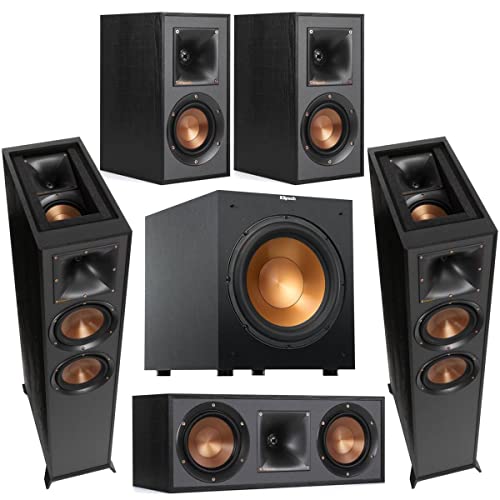
Klipsch Reference 5.1 Dolby Atmos System
5.1 package with Atmos towersTwo R-625FA towers with built-in up-firing elevation drivers, an R-52C center, R-41M surrounds and a 12 inch R-12SW sub. One box covers every position in the 5.1 layout below, and the towers add the height layer for 5.1.2.
Polk Audio 5.1 Home Theater System
Budget-friendly 5.1 packageTwo T50 towers, a T30 center, two T15 bookshelf surrounds and a PSW10 10 inch sub. The bookshelf surrounds are light enough to wall-mount at the 90 to 110 degree positions, and Polk notes the set can grow to 7.1 later.

Denon AVR-X2800H
Receiver for 5.1, 7.1 or 5.1.27.2 channels at 95 W each with 8K HDMI, dual subwoofer outputs and Audyssey calibration. Seven amplified channels run a full 7.1 layout or 5.1.2 Atmos, and dual subs help smooth the room modes covered in the subwoofer section.

Denon AVR-X3900H
Receiver for 7.1.49.4-channel processing at 105 W per channel, Audyssey MultEQ XT32 with an optional Dirac Live upgrade, and support for 7.1.4 or 5.1.6. This is the step up you need for the full 7.1.4 layout in this guide.
Compare every complete system in our best home theater speaker systems guide, and match channel count and power in best home theater receivers. If you are weighing the two most popular 9-channel receivers, see Denon AVR-X3800H vs Marantz Cinema 50.
As an Amazon Associate we earn from qualifying purchases. Prices are approximate Amazon listings when this box was last checked and change often. Picks are researched from manufacturer specifications and verified owner reviews, not hands-on testing, and are not professional installation advice.
Table of Contents
Start With the Listening Position
Your main listening position (MLP) is the reference point for every angle and distance in this guide. Measure angles as the horizontal degrees between your center line (a straight line from your seat to the screen, which is 0°) and an imaginary line from your seat to each speaker. Ear height when seated is typically 3.5 to 4 feet from the floor - that is the target height for your front speakers' tweeters.
If you can, place all bed-level speakers an equal distance from the MLP so sound arrives from every channel simultaneously. Use the speaker sizing calculator to match speaker size and subwoofer output to your room volume before you mount anything.
5.1 Speaker Placement
A 5.1 system has three front speakers, two surrounds, and a subwoofer. This is the foundation every larger layout builds on.
- Front Left & Right: 22–30° off the center line, tweeters at ear level, toed in toward the seat. Spacing roughly equals their distance to the seat (an equilateral triangle).
- Center: directly below or above the screen at 0°, as close to ear/screen height as possible, angled toward the listeners. The center carries most dialogue, so do not skimp here.
- Surround Left & Right: 90–110° from center - beside or just behind the seat - and about 2 ft above ear level so the surround field stays even across seats.
- Subwoofer: position by ear (see below); placement matters more than the "0.1" label suggests.

Klipsch Reference Premiere RP-600M II (Pair)
Front Left & Right PairHigh-sensitivity bookshelf pair for the 22 to 30 degree front positions. The Tractrix horn keeps imaging locked to the seat when you toe them in, and 94.5 dB sensitivity means any receiver drives them easily.
- 94.5 dB sensitivity
- 6.5" woofer
- Tractrix horn
- 45Hz-25kHz

Polk Audio Signature Elite ES35
Center ChannelSlim center that fits below the screen at the 0 degree position without a deep cabinet, so dialogue stays clear at ear height instead of buried in furniture.
- Slim profile
- Six 3" woofers
- Hi-Res certified
- 89 dB sensitivity
7.1 Speaker Placement
A 7.1 system keeps the 5.1 front stage and splits the surrounds into side and rear pairs for more precise pans and a deeper sound field - ideal for larger or longer rooms.
- Side Surrounds: 90–110° from center, directly to the sides of the seating, ~2 ft above ear level.
- Rear Surrounds: 135–150° from center, behind the seating and spaced 3–5 ft apart, at the same height as the side surrounds.
If your room is too short to put rear speakers a meaningful distance behind the seats, a 5.1 (or 5.1.x Atmos) layout will usually outperform a cramped 7.1. See 5.1 vs 7.1 vs Atmos to choose the right configuration for your space.
7.1.4 & Atmos Height Speakers
Adding the ".4" means four overhead height channels on top of a 7.1 base, for true three-dimensional Dolby Atmos. The seven ear-level speakers keep the positions above; the height speakers add elevation:
- Front Heights / Top Front: ahead of the seat, angled down toward ear level.
- Rear Heights / Top Rear: behind the seat, mirrored.
Height placement uses elevation angles rather than the horizontal angles above, so it has its own rules. Use the Dolby Atmos speaker placement calculator for exact ceiling positions and angles, and our best in-ceiling Atmos speakers guide for gear that aims correctly.
Subwoofer Placement
Room modes are the standing waves that form when a bass wavelength fits the distance between two parallel surfaces in the room, which is why one subwoofer can sound boomy in one position and thin in another without changing a single setting.
Bass is dominated by room modes, so the "best" subwoofer spot is wherever the room cooperates - not a fixed angle. Two reliable methods:
- Corner loading: a front corner maximizes output but can make bass boomy or uneven. Good for small rooms that need volume.
- The subwoofer crawl: temporarily put the sub at your seat, play bass-heavy content, and crawl the room on hands and knees. Wherever bass sounds tightest and most even is the spot to place the sub.
Two subwoofers placed at opposite walls (or opposing corners) smooth response dramatically across multiple seats. Match the sub to your room with the speaker & subwoofer calculator, and see the best home theater subwoofers for picks.

SVS PB-2000 Pro
Dual-Sub Ready 12" SubwooferOur pick for the dual-sub setup described above: one at each opposing wall smooths bass across every seat. The app-based DSP makes level-matching a pair painless after the sub crawl.
- 12" driver
- 550W RMS
- 16Hz extension
- App DSP control
Placement Angles at a Glance
| Speaker | Horizontal Angle | Height | Used In |
|---|---|---|---|
| Front L / R | 22–30° | Ear level | 5.1 / 7.1 / 7.1.4 |
| Center | 0° | Screen / ear level | 5.1 / 7.1 / 7.1.4 |
| Side Surrounds | 90–110° | ~2 ft above ear | 5.1 / 7.1 / 7.1.4 |
| Rear Surrounds | 135–150° | ~2 ft above ear | 7.1 / 7.1.4 |
| Height / Ceiling ×4 | Elevation (see Atmos calc) | Overhead | 7.1.4 |
| Subwoofer | By ear (sub crawl) | Floor | All |
The table above lists the horizontal angle, height and layout for every speaker position in this guide, and the two angles that do most of the work are 22 to 30 degrees for the front left and right pair and 90 to 110 degrees for the side surrounds.
🛒 Ready to buy? See our picks for the best home theater speaker systems.
Common Placement Mistakes
- Surrounds too far forward or behind. Side surrounds belong beside the seat (90–110°), not on the front wall.
- Center speaker buried in a cabinet. Trapped dialogue sounds muffled - keep the center clear and aimed at listeners.
- Speakers at wildly different distances without calibration. Always run your receiver's room correction after placement.
- Ignoring height for surrounds. Ear-level surrounds work for a single row, but raising them ~2 ft evens out multi-row rooms.
- Subwoofer shoved wherever it fits. Spend ten minutes on the sub crawl - it is the cheapest upgrade you will ever make.
Frequently Asked Questions
What angle should surround speakers be placed at?
For a 5.1 system, place the side surround speakers at 90 to 110 degrees from the center line (roughly even with or just behind the listening position). For 7.1, the side surrounds sit at 90 to 110 degrees and the rear surrounds go at 135 to 150 degrees behind you. Front left and right speakers belong at 22 to 30 degrees off-center, matching the ITU and Dolby reference layout.
How high should surround speakers be?
Place the front left, center, and right speakers with their tweeters at seated ear level (about 3.5 to 4 feet from the floor). Side and rear surround speakers should sit about 2 feet above ear level - roughly 6 feet from the floor - so the sound field stays even across multiple rows of seating.
How far apart should front speakers be?
Position the front left and right speakers so each one forms a 22 to 30 degree angle with your seat, which usually means they are about as far apart as they are from the listening position (an equilateral triangle). Toe each speaker inward so it aims at the main seat. The center speaker goes directly below or above the screen at ear level.
Where should I put my subwoofer?
Subwoofer placement is the least predictable because room modes dominate bass response. Start in a front corner for maximum output, then use the "subwoofer crawl": put the sub at your listening position, play bass-heavy material, and crawl around the room to find where bass sounds most even - that spot is where the sub should go. Dual subwoofers placed at opposite walls smooth response further.
What changes for a 7.1.4 Atmos layout?
A 7.1.4 system keeps the same seven ear-level speakers as 7.1 and adds four overhead height channels. The front height/ceiling pair goes slightly in front of the seat and the rear pair slightly behind, both angled down toward ear level. Height placement has its own elevation rules - use the Dolby Atmos placement calculator for exact ceiling angles, and see our in-ceiling speaker guide for gear.
Do all speakers need to be the same distance from the seat?
Ideally yes - equal distances mean sound from every channel reaches you at the same time, preserving the surround effect. In practice, rooms rarely allow it, so use your AV receiver's automatic room calibration (Audyssey, YPAO, Dirac, etc.) to set per-speaker distance and level. The receiver delays closer speakers so everything arrives in sync.
How should rear surround speakers be placed in a 7.1 system?
Place the rear surround speakers at 135 to 150 degrees behind the listening position, about 2 feet above ear level, with the side surrounds at 90 to 110 degrees. Aim them at the listening seat, and keep them the same distance from the seat as the other speakers if possible.
Should surround speakers point at the listener?
Yes for most direct-radiating surround speakers. Aim them at the listening position, or slightly past it so the sound is spread across the seats. Dipole and bipole surrounds are different, as they are meant to fire along the wall.
How high should 7.1 rear surround speakers be?
Mount 7.1 rear surround speakers about 2 feet above ear level, roughly 6 feet from the floor, the same as the side surrounds. Mounting them higher than that makes the sound seem to come from above, which belongs to the height channels.